Sewer Area Implementation Plan for the Downtown Area and Palm Drive Corridor
The City of Desert Hot Springs (City) has coordinated with Engineering Resources of Southern California (ERSC) to conduct a feasibility study, the Sewer Area Implementation Plan for the Downtown Area and Palm Drive Corridor, to support new development of local affordable housing. The project is funded through a grant administered by the Southern California Association of Governments (SCAG) as part of the Regional Early Action Planning Grants (REAP) program.
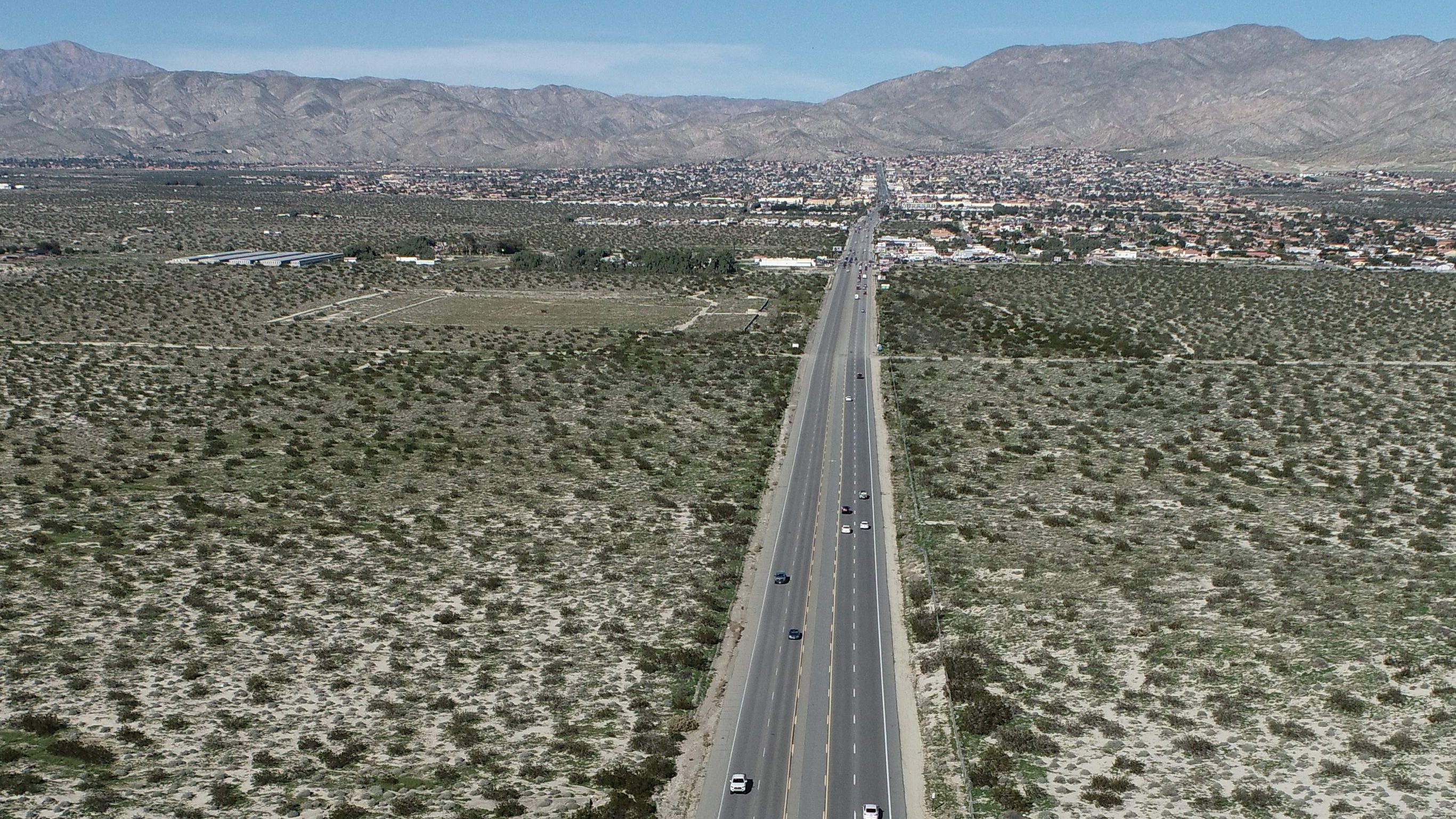
The study area is shown to the left, starting with the Downtown Area in the north, extending south along Palm Drive to 20th Avenue. Click on the links to the aerial videos for a bird’s eye view of the Palm Drive corridor.
The goal of the study is to recommend improvements to local utilities to encourage affordable housing development. The study will include identifying existing sewer infrastructure, quantifying residential development demand, conducting public outreach, performing conceptual design of improvements to meet the demand, and formulating a funding and implementation plan for the proposed improvements.
The community will have multiple opportunities to participate in the planning process. ERSC will develop and conduct two online surveys to gather community input on housing needs and preferences. The survey results will be discussed at community outreach events. The public is encouraged to participate in surveys and outreach events and to provide written comments on the project. This input will serve as a basis for recommending the associated utility infrastructure. Your feedback and knowledge of your community will positively influence the progression and success of this project. We look forward to seeing you!
Meet the Stakeholders
The project is funded through a grant administered by the Southern California Association of Governments (SCAG) as part of the Regional Early Action Planning Grants (REAP) program. The City of Desert Hot Springs is the grantee, and ERSC is the consultant preparing the feasibility study.

Founded in 1965, the Southern California Association of Governments (SCAG) is a joint powers authority (JPA) under California state law, established as an association of local governments and agencies that voluntarily convene as a forum to address regional issues. Under federal law, SCAG is designated as a metropolitan planning organization. Under state law, SCAG is designated as a regional transportation planning agency and a council of governments.
The SCAG region encompasses six counties (Imperial, Los Angeles, Orange, Riverside, San Bernardino, and Ventura) and 191 cities, including Desert Hot Springs, spanning more than 38,000 square miles. The agency develops long-range regional transportation plans, including a sustainable communities strategy and a growth forecast; regional transportation improvement programs; regional housing needs allocations; and a portion of the South Coast Air Quality Management Plan.
For more information, visit the SCAG website: About us | Southern California Association of Governments

ERSC – Engineering Resources of Southern California, Inc. (ERSC) was formed in 1996 with the asset purchase of NBS/Lowry, Inc. Our team is committed to serving Special Districts, Regional Agencies, and Municipalities in Southern California’s public sector with a comprehensive set of professional services and solutions. For this project, ERSC will be providing public outreach, stakeholder coordination, conceptual utility design, cost estimating, construction grant acquisition, and geographic information systems services.
For more information, visit the ERSC website: Home | ERSC, Inc.

Desert Hot Springs was incorporated in 1963 and has a City Council-City Manager form of government. Its governing body, the Desert Hot Springs City Council, is composed of five members, including the mayor, all elected by city residents. Council members serve four-year terms; the Mayor serves a four-year term with a two-term limit.
Municipal elections are consolidated with the general election and held every two years in November of even-numbered years. Council terms overlap: two Council members are elected every two years, and the mayor is elected every four years. Each year in December, the Mayor Pro Tem is selected by the Mayor and ratified by the majority of the City Council.
Desert Hot Springs is among more than 300 cities in California operating under the Council-Manager form of government. The Council hires the City Manager, who is the chief administrative officer of the City, and hires the City Attorney, who serves as the City’s primary legal advisor.
For more information, visit the City website: Welcome – Desert Hot Springs, CA
 What's Next Desert Hot Springs?